
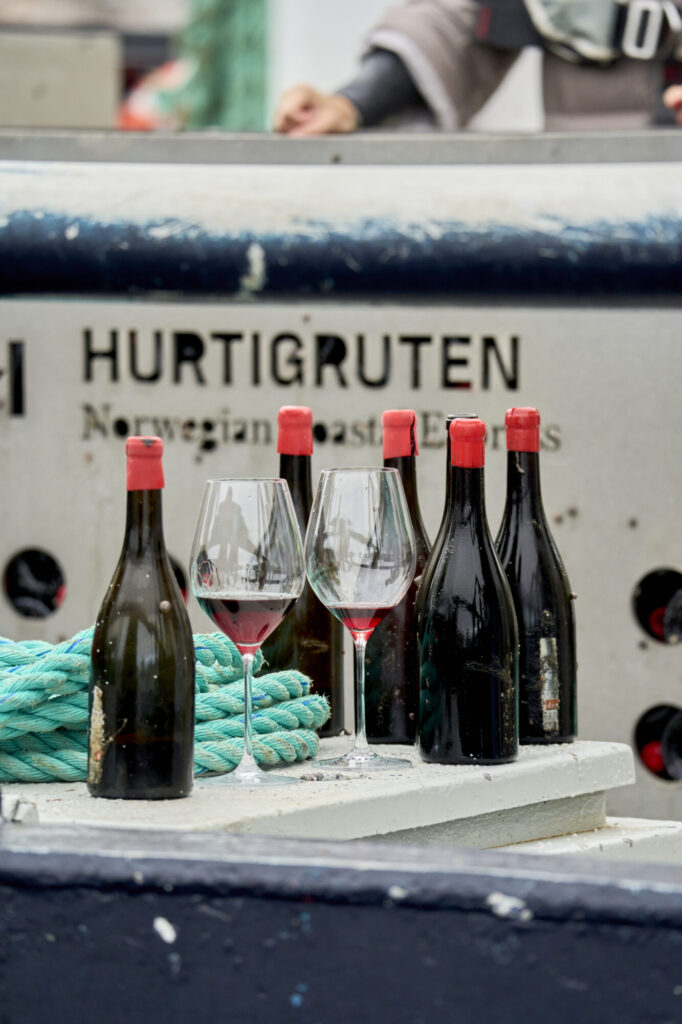
There is now a Barolo you can only drink at 70 degrees north. Rivetto, a biodynamic estate in Serralunga d’Alba, and Hurtigruten, the Norwegian coastal shipping line, announced this week that 1,002 bottles of Rivetto’s 2021 Barolo have been raised from the seabed off Kirkenes, in Arctic Norway, after twelve months at 34 meters. They are calling it Arctic Barolo, and according to the two companies it is the first Barolo ever aged in Arctic waters.
We have covered underwater wineries and sea-aged wine before, and this project stands out for two reasons: the water is colder and further north than anything we have seen, and the wine is a serious Serralunga Barolo rather than a bottling made for the experiment. Winetraveler has not tasted Arctic Barolo. The details below come from the joint announcement Rivetto and Hurtigruten issued on September 21, unless noted otherwise.

What Happened
Rivetto took its 2021 Barolo from the commune of Serralunga d’Alba, a finished wine that had already completed 24 months in large oak casks, and shipped 1,002 bottles to the top of Norway. The bottles were lowered to the seabed off Kirkenes, in Finnmark, a few kilometers from the Russian border and about as far north and east as mainland Norway goes.
According to the companies, the bottles spent the year in near-constant water of 5 to 6°C (41 to 43°F), in total darkness, at a pressure of around 4 bar, roughly four times what a bottle experiences in a cellar. Rivetto describes the goal as observing “what would happen to a Barolo that had already completed its traditional ageing process when exposed, for an extended period, to the distinctive conditions of the Arctic sea.” This was not an attempt to make Barolo underwater. It was a finished wine placed in a very different cellar for a year, with a control batch left at home in Serralunga for comparison.
The installation was designed to be fully retrievable, and the companies say every bottle and every piece of equipment was removed from the seabed at the end of the twelve months.
Fun Fact: Hurtigruten means “the fast route” in Norwegian. The service began in 1893 as a mail and passenger line linking coastal towns that had no road between them, and it has sailed the same coast ever since.

The First Tasting: Cellar Bottle vs. Seabed Bottle
The bottles were opened for the first time on board Hurtigruten’s MS Kong Harald, side by side with bottles of the same 2021 Barolo that had spent the same twelve months in Rivetto’s cellar. Henrik Dahl Jahnsen, President of the Norwegian Sommelier Association, led the comparison.
That result runs the opposite way from what people usually expect of sea-aged wine. The common pitch is that the sea speeds things along and delivers a rounder, more mature wine sooner. Dahl Jahnsen describes an Arctic bottle that came up younger than its cellar twin: brighter color, fresher fruit, firmer tannin. It makes sense. Five degrees in the dark at four bar is a slower environment than a Langhe cellar, not a faster one. If the account holds, the Arctic pressed pause on this Barolo for a year, and for a wine most of us cellar for a decade or more, that is a useful thing to know.
That being said, the tasting was arranged by the partners rather than run blind or independently, and no lab analysis has been published alongside the notes. Rivetto itself says the result “is not intended to provide definitive answers.” Enrico Rivetto, who runs the estate, put it this way: “The most interesting part for me was precisely not knowing what would happen. Wine is alive and continues to evolve over time. Tasting the two bottles side by side and perceiving such a clear difference was both surprising and fascinating.”

How Arctic Barolo Compares to Other Sea-Aged Wines
Sinking wine on purpose traces back to a shipwreck. In 2010, divers off the Åland Islands in the Baltic recovered 168 bottles of Champagne that had been on the seabed since the 1840s, and the scientists who analyzed them, led by Philippe Jeandet, found wine that was still drinkable and in some respects remarkable. Veuve Clicquot returned to those waters a few years later and sank bottles of its own for a long-term experiment. Since then the idea has spread. Edivo in Croatia ages wine in amphorae off the Pelješac peninsula and lets visitors dive for it. Crusoe Treasure in the Basque Country built an underwater winery in the Bay of Plentzia.
Every one of those projects sits in temperate water, and most use wines made for the purpose. Kirkenes is Arctic in every sense of the word, and Serralunga Barolo is one of the most structured, longest-lived wines Italy produces. That combination is what makes the “younger, not older” result worth paying attention to. What we would still like to know: whether any chemical analysis was run on the two batches, how many bottles were compared, how the closures held up at 4 bar, and whether any bottles are being held back for a five- or ten-year comparison. The companies call this “the first chapter.”
How to Taste Arctic Barolo
You can’t buy it. The 1,002 bottles are being served exclusively on board Hurtigruten ships along the Norwegian coast, so the only way to taste Arctic Barolo is to sail the route where it aged. The classic voyage runs between Bergen and Kirkenes, crossing the Arctic Circle, threading the Lofoten Islands and calling at Tromsø before turning around at the top of the country. In winter you sail under the northern lights. In June the sun doesn’t set. The companies haven’t said how many bottles are allocated per ship or how long the supply will last, so if this is on your list, we’d go sooner rather than later.
RELATED: Visiting Svalbard, Norway: An Explorer’s Arctic Dream
Visiting Rivetto in Serralunga d’Alba
The easier way to taste Rivetto is at the source. The family has farmed the hill of Lirano, between Sinio and Serralunga d’Alba, since 1902, and under Enrico Rivetto it has become a biodynamic farm where vines share the slopes with orchards, herbs, cereals and a few resident donkeys. The estate welcomes visitors for wine tastings and for what it calls experiences in nature, both booked in advance through its website, and it has its own suites if you’d like to stay among the vineyards. We’ve added Rivetto to our winery directory.
Serralunga sits on the eastern ridge of the Barolo zone, about twenty minutes from Alba, and its castle is the landmark you’ll see from most of the commune’s vineyards. Our Piedmont destination guide, our Langhe, Roero and Monferrato itinerary and our guide to Piedmont wine tours and tastings cover the rest of the trip.
Photos supplied by Rivetto and Hurtigruten. Photography by Max Emanuelson and Kristian Dale. Winetraveler was not compensated for this coverage and has not tasted Arctic Barolo.