
Editor’s Note: Today, we’re a bit spoiled in that we have the Champagne specialist from Moët Hennessy explaining the rules of thumb behind champagne food pairings. In this article, Alyse Mizia explains the various styles of food that work well with champagne, along with some of her top picks for specific dishes that work exceptionally well with this famous style of sparkling wine.
Champagne's high acidity, scrubbing bubbles, and toasty autolytic (yeast-aged) notes make it a fat-, salt-, and fry-cutting powerhouse. It carries everything from oysters and caviar to fried chicken and potato chips, with the style matched to the dish's weight.
Champagne Food Pairings at a Glance
| Food | Recommended Wine | Why It Works |
|---|---|---|
| Oysters & raw shellfish | Blanc de Blancs (Brut) | All-Chardonnay chalky minerality and searing acidity echo the briny liquor; bubbles lift the cold slippery texture without adding weight |
| Fried chicken | Brut NV or Blanc de Noirs | CO2 and acidity cut rendered fat and batter; the wine's body and Pinot fruit stand up to the savory crust |
| Potato chips & salty snacks | Brut NV | Salt makes the fruit taste rounder while acidity resets the palate between salty, oily bites |
| Sushi & sashimi | Blanc de Blancs (Brut/Extra Brut) | Low dosage keeps sugar from clashing with vinegared rice; delicate body won't bury raw fish; acidity offsets soy and fatty tuna |
| Brie & triple-cream cheese | Blanc de Noirs or vintage Brut | Acidity and bubbles cleanse the fat-coated palate; bready autolytic notes mirror the mushroomy rind |
| Caviar | Blanc de Blancs (Brut/Extra Brut) | Bone-dry, mineral, low-dosage style keeps sweetness from fighting the salt; fine bubbles refresh the oily, briny roe |
| Fish & chips | Brut NV | Effervescence and acidity slice fryer oil and tartar sauce the way lemon does; light body keeps pace with flaky fish |
| Buttered popcorn | Brut NV or Blanc de Noirs | Bubbles scrub butter fat; toasty brioche notes echo the roasted-corn flavor; salt makes the wine read fruitier |
| Gougères (cheese puffs) | Blanc de Blancs or Brut | The classic Champenois pairing: yeasty cheesy pastry mirrors the wine's brioche character; acidity cuts the butter and Gruyère fat |
| Smoked salmon | Rosé or Blanc de Noirs (Brut) | Pinot structure and red-berry fruit stand up to oily smoky fish; acidity and bubbles cut the fat |
| Roast turkey | Rosé or Blanc de Noirs (Brut) | Pinot-driven body and gentle fruit match poultry and trimmings; acidity refreshes against rich gravy |
| Fruit tart & desserts | Demi-Sec | Only a sweeter dosage can meet dessert sugar; a drier wine would taste sour and thin against the fruit and pastry cream |
How To Pair Food with Champagne
There are few foods that do not pair with Champagne! The rule of thumb is that any food with salt, butter, oil, or fat will work well. In fact, popcorn makes for a perfect Champagne pairing. Dinner and a movie anyone?
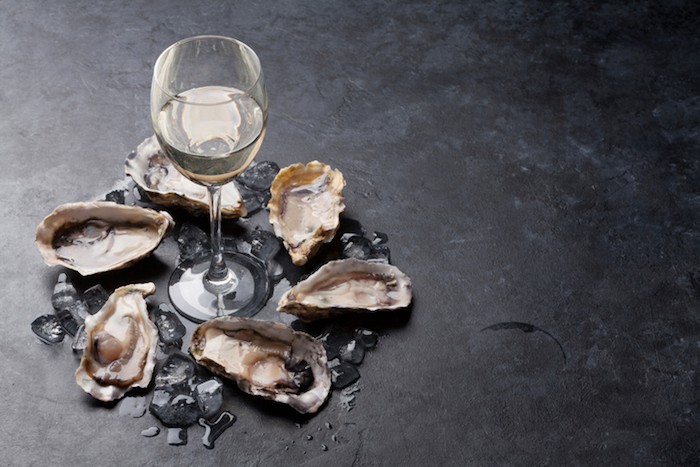
Some of my favorite pairings are a toasty, Brut-style of Champagne with a Rotisserie Chicken, or a Brut Rosé with Pepperoni Pizza… but Truffle Fries are always a winner. Oysters are also a fantastic and classic pairing. Try Raw Oysters with a Dry Champagne and consider a Brut with Fried Oysters or Scallops.
Understanding The Dynamics of Food & Champagne Pairings
The crisp acidity of Champagne cuts through any fats on the palate, dancing with the food, and making you want to come back for more. Don’t be afraid to think outside of the box, especially when pairing complex styles of Champagne, as they can lend themselves to unexpected pairing discoveries.
While Champagne is often thought of as a wine that’s best used to get the evening started, it is in fact a wine that can carry you through a full meal, and perhaps on to the next morning.
Side Note: When drinking Champagne, drink from a regular wine glass! Unless you have been blessed with a petit nose (unlike myself), it’s near to impossible to get your nose into a flute to fully experience all that these wines have to offer. Oliver Krug told me once that drinking Champagne from a flute is “like wearing earplugs to the orchestra – all of the components are there, but you cannot experience them.”
More Ways To Discover Champagne & Sparkling Wine
A Wine Lover’s Travel Guide To The Champagne Region
Itinerary: How To Spend 2 Days in Champagne
Sparkling Wine vs. Champagne – What’s The Difference?
Putting on the Spritz: The Rise of English Sparkling Wine
How to Pair Champagne Food Pairings
- Match sweetness to the plate: Brut/Extra Brut for savory and fried food, Demi-Sec strictly for dessert (a dry wine tastes acidic next to sugar).
- Let bubbles and acidity work on fat and fried food — they physically scrub oil off the palate and reset it, why Champagne loves fried chicken and chips.
- Choose Blanc de Blancs (all Chardonnay) for delicate seafood, oysters, sushi and caviar — its lean minerality won't overpower fine textures.
- Reach for Blanc de Noirs or Rosé (Pinot) for richer/savory dishes, poultry, smoked salmon and creamy cheese, where body and fruit are needed.
- Remember salt loves bubbles: salty oily snacks make Champagne taste rounder and fruitier while the wine cleanses the salt.
- Lean on toasty autolytic notes to bridge roasted, fried and cheesy flavors — gougères and popcorn work because the wine already tastes of brioche.
How Champagne Is Made
The bubbles that make Champagne such a versatile partner at the table are the product of a specific process, the méthode champenoise (also called the traditional method). It begins with a still base wine, usually blended from several plots and vintages. That wine is bottled with a measured dose of yeast and sugar known as the liqueur de tirage, which triggers a second fermentation inside the sealed bottle. This is where the carbon dioxide is trapped and the wine gains its pressure and fizz.
- Aging on the lees: The spent yeast cells (the lees) rest in contact with the wine as it matures. Non-vintage Champagne must age a minimum of 15 months, while a declared vintage must age at least three years. This slow contact builds the brioche, toast, and biscuit notes that define the style.
- Riddling and disgorgement: Bottles are gradually turned and tilted (remuage) to collect the sediment in the neck, which is then frozen and expelled (disgorgement).
- Dosage: A final top-up of wine and sugar, the liqueur d’expédition, sets the sweetness.
Only sparkling wine from the delimited Champagne region of France, made chiefly from Chardonnay, Pinot Noir, and Pinot Meunier, may carry the name.
Understanding Champagne Styles
Reading a Champagne label tells you a great deal about how the wine will taste before you pull the cork, which makes pairing far easier. The most useful clue is the sweetness scale, set by the dosage:
- Brut Nature / Zéro (0–3 g/L) and Extra Brut (0–6 g/L): bone-dry, taut, and mineral.
- Brut (up to 12 g/L): the most common style, dry but balanced.
- Extra Dry (12–17 g/L), Sec (17–32 g/L), and Demi-Sec (32–50 g/L): progressively sweeter, with Demi-Sec suited to dessert.
Other terms describe the blend. Non-Vintage is a house’s consistent multi-year style; Vintage comes from a single strong year and shows more depth. Blanc de Blancs is all Chardonnay, lean and citrusy; Blanc de Noirs is made from black grapes, rounder and fuller. Rosé adds red-wine character and berry fruit, while a Prestige Cuvée is a house’s flagship bottling.
Finally, check the small code near the bottom. RM (Récoltant-Manipulant) marks grower Champagne, made by the same estate that farms the grapes, often more terroir-driven; NM (Négociant-Manipulant) marks the large houses that buy fruit and blend for consistency.
Frequently Asked Questions
What is the best all-around Champagne for food?
A Brut Non-Vintage is the most versatile choice. Its balance of bright acidity, fine bubbles, and modest dosage cuts fat and salt while staying dry enough for savory food, making it reliable from appetizers through the main course.
Why does Champagne pair so well with fried food?
Fried food coats the palate in fat and oil. Champagne's bubbles and high acidity physically scrub that coating away and refresh the mouth between bites, like a squeeze of lemon, so each bite of fried chicken or chips tastes as crisp as the first.
Is sweet or dry Champagne better with dessert?
Sweet wins. A dessert must be less sweet than the wine, or the wine turns sour and thin. Demi-Sec has enough sweetness to stand up to fruit tarts and pastries; a Brut would clash.
What Champagne goes with oysters and caviar?
Blanc de Blancs, made entirely from Chardonnay, is the classic match. Its chalky minerality and razor-sharp acidity echo the briny, saline flavors, while a low-dosage Brut or Extra Brut keeps sweetness from fighting the salt.
Can you drink Champagne with cheese?
Yes, especially soft, creamy styles. Brie and triple-cream cheeses coat the palate with fat that Champagne's acidity and bubbles cleanse, while the wine's toasty autolytic notes mirror the mushroomy rind. Fuller Blanc de Noirs handles the richest cheeses.
What is the difference between Blanc de Blancs and Blanc de Noirs for pairing?
Blanc de Blancs is 100% Chardonnay: lean, mineral and delicate, ideal for seafood, sushi and caviar. Blanc de Noirs is from black grapes (Pinot Noir/Meunier): fuller-bodied and fruitier, better for poultry, smoked salmon and rich cheese.


Collect your Winetraveler passport — tap the regions & grapes you’ve tasted. Your stamps follow you across the whole site.
- Curious1 stamps
- Explorer3 stamps
- Connoisseur6 stamps
- Sommelier12 stamps
- Vigneron20 stamps
Your stamps are saved on this device.