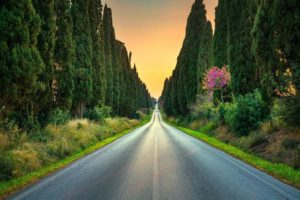
Wine city
For sun, sand, and sea, head to the Tuscan coast's pristine beaches, such as Forte dei Marmi, Viareggio, or Castiglione della Pescaia.
The Tuscan Coast — the Maremma, running down the Tyrrhenian from Livorno toward Grosseto — is Tuscany's other wine country: warmer, wilder and more Mediterranean than the Sangiovese hills inland. This is where the "Super Tuscans" were born. At Bolgheri, on the gravelly flats behind the coast, estates like Sassicaia and Ornellaia proved that Cabernet Sauvignon, Merlot and Cabernet Franc could make world-class wine in Italy, under what is now the Bolgheri DOC.
South of Bolgheri the Maremma opens into a patchwork of appellations — Val di Cornia and Suvereto, and further down the Sangiovese-based Morellino di Scansano near Grosseto — with a growing number of organic estates and far fewer crowds than Chianti. The coast pairs vineyards with the things you actually want on a summer trip: long sandy beaches at Forte dei Marmi, Castiglione della Pescaia and the Golfo di Baratti, pine forests, and the wild Maremma countryside of grazing cattle and hot springs.
The coast is easy to reach by train down the Rome–Genoa line or by car from Pisa or Florence, but a car is what lets you link the cypress-lined estate drives with a beach afternoon. May, June and September are ideal — warm and open, but before and after the August rush. Use the guide below to plan which Bolgheri and Maremma estates to book.