
First, when pairing wines and food, I always suggest eating and drinking what you like, but many people like some help in discovering what can create those amazing food matches. Consider the intensity of your wine or food and go from there.
Cabernet Sauvignon's high tannin and full body demand fat and protein — think grilled red meat and hard aged cheese, which soften its grip. It clashes with delicate white fish (metallic) and very spicy food (tannin amplifies heat).
Cabernet Sauvignon Food Pairings at a Glance
| Food | Recommended Wine | Why It Works |
|---|---|---|
| Grilled ribeye steak | The classic anchor; well-marbled ribeye with a charred crust | Fat and protein bind the astringent tannins, softening them, while the grill char echoes Cabernet's own toasty, structured profile |
| Lamb chops | Rack or loin chops, ideally with rosemary and garlic | Lamb's richness and gamey fat coat the palate so tannin reads as smooth structure; herbal notes bridge to Cab's savory side |
| Braised short rib | Slow-braised, fork-tender beef in a reduced sauce | Collagen and rendered fat plus concentrated umami tame tannin; the wine's acidity cuts through the unctuous braise |
| Burgers | A fatty patty, sharp cheese, no sweet toppings | Fat and protein blunt tannin; keep it savory since ketchup/relish sweetness fights the wine's dry edge |
| Aged cheddar | Sharp, crumbly, aged 2+ years | Milk fat and salt bind tannin; the cheese's savory intensity stands up to Cabernet's full body without being overwhelmed |
| Portobello mushroom | Grilled or roasted vegetarian anchor | Deep umami and a meaty, dense texture give tannin something to grip; roasting adds char that mirrors the wine's structure |
| Dark chocolate (70%+) | High-cacao only — never milk or sweet chocolate | Cocoa's own bitterness and tannin run parallel to the wine's; both are dry and structured, meeting as equals rather than clashing |
| Roasted root vegetables | Carrots, parsnips, beets caramelized with olive oil | Roasting concentrates sugars and adds char/umami, giving a vegetarian dish enough body and savory depth to meet the tannin |
| Blue cheese | Works, but choose a milder, creamier blue | Fat and salt tame tannin, but very pungent blues (Roquefort) can turn the wine metallic — creamier styles are safer |
| Pepper steak (au poivre) | Cracked black-pepper crust on a seared steak | Peppercorn's spice resonates with Cabernet's peppery, herbal aromatics; the beef fat still handles the tannin |
| Hard aged cheeses | Parmigiano-Reggiano, aged Gouda, aged Manchego | Low moisture, high fat and crystalline savory intensity are ideal tannin binders — the harder and older, the better |
| Delicate white fish (AVOID) | Sole, cod, tilapia — skip Cabernet here | Tannin reacts with the fish's oils to produce a metallic, fishy off-taste, and the wine's weight flattens the fish's subtle flavor |
Cabernet Sauvignon is a big wine with intense flavor, full body and structure (acids and tannin). A wine like this needs to be paired with richer more intense foods – delicate dishes would be overwhelmed.
Classic Cabernet Sauvignon Food Pairing
There are a few “classic” food pairings for Cabernet. Meats like lamb and steak naturally work with Cab because the meats are high in fatty proteins which coat your mouth with fat. The high levels of tannin in Cabernet bind with the proteins of the meat and clear your palate making your mouth ready for the next bite.
Cabernet From Different Regions & Climates May Call for Different Food Pairings
Region can affect flavors, aromas, weight, tannin and acid in a wine. These factors should be considered when pairing food and wine.
RELATED: How To Pair Bordeaux Red Wines With Food
RELATED: The Essential Guide to Pairing Malbec Food Pairing
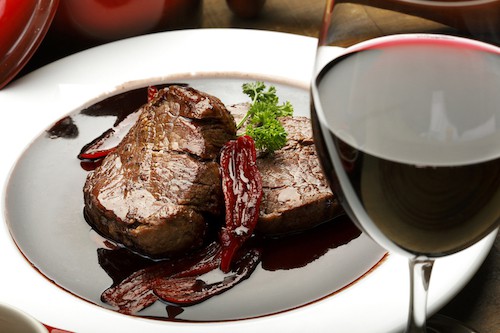
Warmer climate Cabernet like those from Napa, Argentina, Spain or Australia, will be fuller in body, have softer tannins in youth and are typically “fruitier”. Try pairing these wines with heavier more complex dishes and sauces. Incorporating salt, acid or fruit flavors may enhance these wines. Try a Balsamic glaze with beef tenderloin paired with a Napa Cab or even a Bacon Cheeseburger with a great cab from Australia.
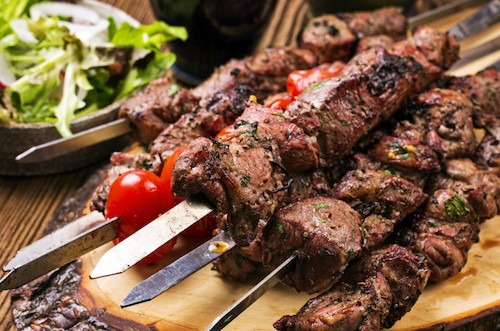
Cooler climate Cabernets will be slightly leaner, younger wines may have “grippy” tannins and more herbaceous flavors, like wines from Bordeaux, Chile or Washington State. These wines pair better with simpler dishes and sauces. Herbed lamb kabobs would pair well with a Bordeaux from Medoc. Try a Washington Cabernet with meatloaf and herbed mashed potatoes.
Experiment with different flavors in food and wines, see what combinations work and what you enjoy the most!
How to Pair Cabernet Sauvignon Food Pairings
- Feed the tannin: always pair Cabernet with fat and protein (marbled red meat, hard cheese), which chemically bind the tannins and turn astringency into smooth structure.
- Match the char: grilling, searing, and roasting create browned bitter-savory crusts that echo Cabernet's structure and oak — cooking method matters as much as the ingredient.
- Avoid heat: capsaicin and tannin amplify each other, so skip chili-forward spicy food; the wine tastes harsher and the dish burns hotter.
- Skip delicate fish: tannin reacts with fish oils to create a metallic clash, and Cabernet's weight overwhelms subtle seafood — save it for red meat.
- Read the style: riper New World Cabernet (Napa) has softer tannin and fruit for barbecue and burgers, while savory higher-acid Bordeaux leans to lamb, herbs, and classic roasts.
- Decant young Cabernet: an hour of air softens tight tannins, making it far friendlier at the table.
A Short History of Cabernet Sauvignon
For a grape with such global reach, Cabernet Sauvignon is surprisingly young. It was born in southwestern France, and for centuries its exact parentage was a matter of guesswork. That changed in 1997, when a team led by geneticist Carole Meredith at UC Davis used DNA profiling to prove that Cabernet Sauvignon is a natural cross of Cabernet Franc and Sauvignon Blanc. The Sauvignon Blanc link came as a genuine surprise, and the accidental crossing most likely happened in a Bordeaux vineyard sometime in the 17th century.
The grape rose to prominence in the Medoc, on the left bank of the Gironde. Once the region’s marshes were drained in the 18th century, the exposed gravel banks proved ideal for ripening Cabernet’s thick-skinned, late-ripening berries. That reputation was cemented by the 1855 Bordeaux classification, which ranked the Medoc’s leading estates by market price. Cabernet’s global moment came in 1976 at the Judgment of Paris, when French judges in a blind tasting rated a Napa Valley Cabernet above celebrated Bordeaux, upending assumptions about where great Cabernet could grow. Today it is the world’s most widely planted wine grape.
Cabernet Sauvignon Around the World
Cabernet Sauvignon is a chameleon that reflects where it grows, and climate is the clearest dividing line: cooler sites push the wine toward herbal, structured expressions, while warmer sites yield riper, more fruit-forward styles. In its Bordeaux home, particularly the gravel soils of the Medoc, it is firm and structured, built on cassis, cedar, and graphite, and almost always blended with Merlot and Cabernet Franc for balance.
Cross to warmer California, and Napa and Sonoma turn out plusher wines with jammy black fruit, softer tannins, and higher alcohol. Elsewhere the signatures shift again. Coonawarra’s terra rossa soils in Australia give minty, eucalyptus-tinged Cabernet, while Chile’s Maipo and Colchagua valleys deliver herbal, green-pepper notes and dependable value. In Tuscany, Cabernet powers the Bordeaux-inspired “Super Tuscans” of the coast, blending Italian warmth with real structure. South Africa’s Stellenbosch leans savory and restrained, more food-friendly than Napa, and Washington State splits the difference with ripe fruit framed by firm acidity. One grape, many accents, each shaped by soil and sun.
Frequently Asked Questions
What food pairs best with Cabernet Sauvignon?
Fatty, protein-rich red meat is the best match — grilled ribeye, lamb chops, and braised short rib top the list. Their fat binds Cabernet's high tannins, softening the wine while the meat's richness stands up to its full body.
Why does Cabernet Sauvignon pair so well with steak?
Steak's fat and protein bind to the wine's astringent tannins, so the wine tastes smoother and the meat tastes richer. A charred, grilled crust also mirrors Cabernet's toasty, structured profile, making it the textbook red-meat-and-red-wine pairing.
What should you not pair with Cabernet Sauvignon?
Avoid delicate white fish, which turns metallic against tannin, and very spicy food, which amplifies the wine's bitterness and the dish's heat. Sweet dishes and light, subtle flavors also get overwhelmed by Cabernet's weight and grip.
Does Cabernet Sauvignon go with cheese?
Yes — hard, aged, salty cheeses like sharp cheddar, Parmigiano-Reggiano, and aged Gouda are ideal, since their fat and salt tame the tannins. Very pungent blue cheeses are risky and can turn the wine metallic, so choose creamier, milder blues.
Can you pair Cabernet Sauvignon with chocolate?
Only high-cacao dark chocolate (70% or more). Its bitterness and tannin run parallel to the wine's, so they meet as equals. Milk or sweet chocolate clashes badly, making the dry, tannic Cabernet taste bitter and harsh.
Is Napa or Bordeaux Cabernet better for food pairing?
Both pair well but differently. Riper Napa Cabernet has softer tannin and fruit that flatters burgers and barbecue, while savory, higher-acid Bordeaux suits lamb, herb-crusted roasts, and classic French dishes. Match the wine's style to the dish's intensity.