St. Laurent at a Glance
Structure
- Body Medium
- Sugar Dry - Sweet
- Acid Medium
- Alcohol Medium
- Tannins Medium Plus
The Shape of St. Laurent
Each spoke runs from delicate (centre) to pronounced (edge). Tap a benchmark to lay a familiar grape over the top.
More About St. Laurent
St. Laurent: Delicate and Savage
St. Laurent is a deceptive grape variety that has no association with the designer Yves St. Laurent, though an internet search might suggest otherwise. DNA profiling indicates that St. Laurent is an offspring of Pinot Noir conceived with an anonymous second parent, but this remains unconfirmed. Still, like other whippersnappers whose birthrights are vague, St. Laurent has a wild side that Pinot Noir lacks. One way to describe St. Laurent at its finest is the capability of expressing the power and spice of a Rhone Valley wine with the elegance and delicacy of a red Burgundy.
The Mysterious Origins of St. Laurdent
St. Laurent's similarities and differences from Pinot Noir are not its only mystery; the origin of its name and provenance are also cloudy. Some attribute it to the Bordeaux village of Saint-Laurent-Médoc in the Gironde department in southwestern France. Others to the August 10th holy day, Feast of St. Lawrence, which is a memorial to the heroic martyr and patron saint of the poor and cooks. The vine was named St. Laurent because this celebration coincides with its berries changing color and becoming edible, a phase known as veraison. However, the real puzzler isn't its calling. It's why the generally accepted country of origin is Austria? Given all the geographic and historic references stemming from Bordeaux. One theory is that an earlier conception of St. Laurent developed in Bordeaux and made its way from France via Alsace and Germany into Austria and the Czech Republic.
Remarkably, all this evidence is valid and correct as St. Laurent is an "autochthonous variety." Meaning it can naturally crossbreed or mutate within its terroir, and throughout its development, the vine adapts to the resident environment and correspondingly articulates itself while maintaining its underlying heritage. In modern viticulture, autochthonous grape varieties are studied as exemplary outgrowths of their terroir and regarded as representative of a region.
Terroir
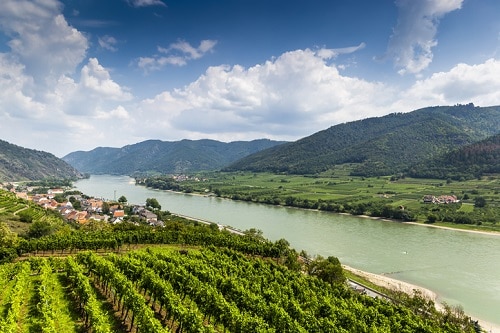
St. Laurent prefers dry, deep, stony alluvial soils composed of limestone clay, silt, and gravel, planted on slopes exposed to the warmth of the sun and cool evening breezes. Currently, St. Laurent is grown in Austria, Germany, Slovakia, California, Canada, New Zealand, and is the most planted red variety in the Czech Republic.
The Structure, Taste & Style of St. Laurent Wines
Although St. Laurent remains a reasonably obscure variety, it has gained the attention of producers in other regions and is considered to have world-class potential. It is traditionally produced as a dry red wine, although there are sparkling, dry rosé and sweet styles. In the glass, its color can range from having a pale red berry or garnet to dark purple or ruby color. The wine is intensely aromatic, developing an extraordinary bouquet of roses, violets, cherries, raspberry, cardamom, tar, sweet cigar tobacco, graphite, and bramble.
In terms of taste, St. Laurent presents flavors of Morello cherry, raspberries, anise, leather, and clay with a harmonic ratio of acid and tannins and a balanced mouthfeel. It ends with lush dark fruit, a bit on the tangy side, and a perceivably structured, yet silky length, resulting in a wine that is savory, intense, and toes a fine line between delicate and savage.
Pairing St. Laurent With Food
St. Laurent is a gastronomic delight that pairs with both Haute and carryout cuisine; some compliments you may consider are Margherita pizza, classic burger, chili Verde, spicy chicken wings, Moo Shu pork, Peking duck, Vietnamese shaking beef, steak au poivre, roasted leg of lamb, lamb shish kebabs, Swedish meatballs, Korean style ribs, baba ghanoush, herb-roasted chicken, chicken makhana, salmon with currants and Catalan bean sausage stew.
Current Countries Producing St. Laurent
The Czech Republic
Austria
Germany
Switzerland: Sankt Laurent
Slovakia: Synonyms: Svätý Vavrinec, St. Laurent, Pinot St-Laurent, Sanktlorenztraube
USA, California
Canada
New Zealand
Major Current St. Laurent Producers by Country
Austria
Claus Preisinger Ancestral Sparkling, Burgenland
Erich Sattler, Burgenland
Brigitte & Gerhard Pittnauer Dorflagen, Burgenland
Juris Selection St. Laurent, Burgenland
Rosi Schuster St. Laurent Klassik, Burgenland
Meinklang Konkret, Burgenland
Keringer Commander, Burgenland
Gernot and Heike Heinrich, Burgenland
Paul Achs, Burgenland
Zantho, Burgenland
Umathum Vom Stein, Burgenland
Brigitte & Gerhard Pittnauer Altenberg, Burgenland
Umathum, Burgenland
R & A Pfaffl Alten, Niederosterreich
Johanneshof Reinisch Holzspur Grand Reserve, Thermenregion
Johanneshof Reinisch, Thermenregion
Stift Klosterneuburg Reserve,Thermenregion
Germany
Anselmann Edesheimer Ordensgut Trocken, Pfalz
Kuntz Sankt Laurent Trocken, Pfalz
Winzergenossenschaft Herxheim Herxheimer Honigsack Trocken, Pfalz
Thomas Hensel Aufwind Trocken, Pfalz
Slovakia
Masaryk, Small Carpathian wine region
LVD Limbach, Small Carpathian wine region
Skovajsa, South Slovak
California, USA
Scribe St. Laurent, Carneros, Carneros
Cruse Wine Co. Sparkling Petillant Naturel, Carneros
Forlorn Hope 'Ost-Intrigen' Ricci Vineyard Carneros
The Czech Republic
Z Czech, Moravia (This is a blanket name for most Czech wine imported to the USA)
Habanske Sklepy Svatovavrinecke
Learn About These Other Wine Grape Varieties
Jeff or “JB” is a native to the San Francisco Bay area and wants to live in a world where wine is served with every meal. As a beverage and food professional with more than 20 years of experience, he’s contributed to The Food Lover’s Guide to Wine; The Pho Cookbook (James Beard Award Best Signal Subject 2018); Unforgettable: The Bold Flavors of Paula Wolfert's Renegade Life (James Beard Award Lifetime Achievement Award 2018); Manresa: An Edible Reflection; Happiness is on the Plate: Episode #1; Wine Spectator; Wine Enthusiast; The Wall Street Journal; San Francisco Chronicle; and GQ Magazine. When he’s not “tasting” and eating he’s writing about food and beverage or developing recipes in his laboratory (AKA: kitchen).
Taste St. Laurent at the Source
St. Laurent is tied to a handful of regions. Explore each as a travel destination — with wineries, tours and guides.
St. Laurent: Frequently Asked Questions
What does St. Laurent taste like?
St. Laurent is a medium-bodied red with juicy sour cherry, dark berry, and plum flavors, often showing spice, forest floor, and a hint of bitter almond. Related to Pinot Noir, it has silky tannins, bright acidity, and an earthy, savory undertone in fuller examples.
Is St. Laurent sweet or dry?
St. Laurent is made as a dry red wine. It offers ripe, juicy dark-cherry fruit and gentle spice without residual sugar, balanced by fresh acidity and soft tannins. Its fruit-forward character can seem generous, but the finished wine is dry and food-friendly.
What foods pair with St. Laurent?
St. Laurent's bright acidity and moderate tannins pair well with roasted poultry, pork, duck, and game. It suits mushroom dishes, root vegetables, and Austrian classics like schnitzel and goulash. Medium-weight and versatile, it also works with charcuterie and semi-hard cheeses.
How does St. Laurent compare to Pinot Noir?
St. Laurent is genetically related to Pinot Noir and shares its silky texture, red-fruit character, and earthy elegance, but tends to be darker, deeper in color, and a touch more robust with firmer structure. It ripens later and can show more brooding, spicy fruit.
Where is St. Laurent grown?
St. Laurent is most associated with Austria, especially the Thermenregion and Burgenland, where it makes serious, structured reds. It is also grown in the Czech Republic (Svatovavřinecké), Slovakia, and Germany. Plantings elsewhere are limited, keeping it a distinctive central European specialty.
How should I serve St. Laurent?
Serve St. Laurent slightly cool, around 58-62°F, to keep its red fruit fresh and lively. Use a Burgundy-style glass to showcase its Pinot-like aromatics. Most examples drink well young, though structured Austrian versions can improve for several years in the cellar.