
On the lower slope of Mount Juktas, a few kilometres south of the village of Archanes, there is a stone basin that most visitors to Crete drive straight past on their way to Knossos. It is shallow and plain, cut to catch liquid and let it run out through a spout into a jar set lower down. You do not need a placard to work out what it did. Grapes went in, feet went to work, and the juice ran downhill to be collected. The basin is roughly 3,600 years old, and it has sat out in the open air since the Bronze Age. It is one of the oldest wine presses still standing in its original place anywhere in Greece.
That press sits at a Minoan country house called Vathypetro, and it is the reason people call Crete the birthplace of Greek wine. It makes a good story. It is also mostly true, as long as you are careful about which claim you are actually making. Get the claim right and the island’s case gets stronger. Get it wrong and you are just repeating brochure copy that any archaeologist can pull apart in a sentence. So it is worth slowing down and getting it right.
What Crete can honestly claim about its wine
Crete is not where wine was invented. On the evidence we have, that honour belongs to the South Caucasus. Neolithic pottery from two villages south of Tbilisi, in what is now Georgia, holds tartaric-acid residue dated to roughly 6000 BCE, two thousand years before the first Cretan farmhouse. Crete does not hold the oldest known winery either. That is the Areni-1 cave in Armenia, a complete pressing and fermentation setup from about 4100 BCE. Crete is not even the site of the oldest wine in Greece. That distinction belongs to the north, at Dikili Tash near Philippi, where archaeologists found a Late Neolithic jar packed with some 2,460 grape pips and pressed-grape debris, and the sherds tested positive for the chemical markers of fermentation. Dikili Tash dates to around 4300 BCE, which puts it more than a thousand years ahead of anything wine-related on Crete.
So here is the honest headline. Crete is where wine in Greece stopped being something people simply did and became something a civilisation was built on. The Minoans are the first people in the Aegean we can actually watch pressing grapes at scale, storing the result in warehouses of matched jars, writing wine into their account books, cooking with it, trading it, and giving it a place in religion. Then they handed the whole apparatus down, more or less unbroken, through a run of cultures that still make wine on the same hillsides today. That is a bigger claim than “oldest,” and it is the one Crete can actually back up.
The long road to a glass of Cretan wine
Where Crete actually sits in the story of wine. The gold markers are Cretan milestones.
- c. 6000 BCEThe oldest known wine anywhere, from Neolithic jars in Georgia.
- c. 4300 BCEThe oldest wine in the Aegean, at Dikili Tash in northern Greece.
- c. 4100 BCEThe oldest known winery, the Areni-1 cave in Armenia.
- c. 3200 to 2700 BCEWine chemically confirmed on Crete, at the Aphrodite’s Kephali fort.
- c. 2200 BCEGrape pips and storage jars at Myrtos, on the south coast.
- c. 1580 BCEThe Minoan wine press at Vathypetro is built near Archanes.
- c. 1450 BCEMycenaeans record wine in Linear B in the palace accounts at Knossos.
- TodayNative grapes first grown here in the Bronze Age still fill the glass.
How we know the Minoans made wine, not just raisins
Ancient wine has an obvious problem for anyone trying to study it. The wine itself is long gone. What survives is grape pips, and pips on their own do not prove winemaking, because people also dried grapes into raisins for winter food. The excavators at Myrtos, an Early Minoan settlement on the south coast, ran straight into that wall. The site produced grape pips and storage jars from around 2200 BCE, but a careful reading admits the seeds could just as easily be the remains of raisins as any sign of wine. Grapes are not wine. You need better proof than seeds.
The better proof is chemistry, and Crete has it. At a hilltop fort called Aphrodite’s Kephali in the east of the island, dating to Early Minoan I, around 3200 to 2700 BCE, archaeologists Philip Betancourt and Andrew Koh ran sherds from the storage jars through gas chromatography. They found two things. Oleic acid, the signature of olive oil, and tartaric acid, the signature of grapes. Tartaric acid is the one that matters. It occurs in real quantity almost nowhere in nature except in grapes, its residue survives for thousands of years in chalky soil, and modern instruments pick it up down to a few billionths of a gram. Find tartaric acid soaked into a storage jar and you are looking at the ghost of wine. The Aphrodite’s Kephali jars are described as the earliest documented presence of both wine and olive oil on Crete, which pushes confirmed Cretan winemaking back more than five thousand years.
The chemistry keeps turning up. At Monastiraki, a settlement of the Old Palace period in the Amari valley, residue analysis found resinated wine not only in storage vessels but inside cooking tripods. The Minoans did more than drink wine. They cooked with it, the way a modern kitchen uses a splash of wine to lift a sauce. Several Cretan sites, Myrtos among them, also show that the wine was treated with pine resin to preserve it, which makes it a Bronze Age ancestor of retsina. Pour a glass of resinated Greek white today and you are tasting a preservation trick four thousand years old.
How Minoan wine was made: treading, spouts and pithoi
The method is legible in the ground, and it is the same one that survived in the Greek countryside into the twentieth century. Grapes went into a shallow basin and were trodden barefoot. The free-run juice, called the must, drained through a spout or channel cut at the base of the basin and dropped into a second vessel set lower down. From there it went into pithoi, the enormous ceramic storage jars, often as tall as a person, that are the signature object of Minoan material culture. The must fermented and the wine stayed in those jars, lined up in rows in dedicated storerooms.

Vathypetro is where you can see the whole sequence laid out. Spyridon Marinatos excavated it across the early 1950s. The villa went up around 1580 BCE, at the start of the Late Minoan IA phase, took bad earthquake damage a generation later, and was rebuilt as an industrial farmstead, a place put together to make things. Along with the wine press it held an olive press, a pottery kiln and a storeroom of around sixteen pithoi. The press survives as its three working parts: a jar for the fruit, a basin to tread it in, and the collecting vessel the must ran into through the spout. It is one of the oldest and best-preserved installations of its kind in the Aegean, which is the accurate way to put it. You will see it billed as “the oldest wine press in the world” on signs and travel sites. It is not. Armenia’s is older by two and a half thousand years, and there is older pressing evidence on Crete itself. It does not need the inflation. A complete 3,600-year-old press you can walk right up to is remarkable enough on its own.
We also know the treading vat was a standard, recognised object, because the Minoans made miniature clay models of it. Scale copies of the pressing vessel have turned up at Vathypetro, Malia, Palaikastro and Zakros. People do not model a shape unless it is familiar enough to be worth copying. In their own small way, those models are a Bronze Age technical drawing: this is what a wine press looks like.
Wine in the Minoan records: Linear A and Linear B
The strongest sign that wine had become an institution rather than a household chore is that the Minoans kept accounts of it. Their clay administrative tablets carry a dedicated sign for wine, the logogram catalogued as AB 131 and read as VIN, which stands for wine and its products, must and vinegar included. The same sign runs through both scripts the island used. Linear A is the still-undeciphered language of the Minoans themselves. Linear B, which came later, turned out to be an early form of Greek used by the Mycenaeans who took over the palaces after about 1450 BCE. The distinction is worth keeping straight. Linear A is genuinely Minoan and earlier. The famous Knossos wine tablets are Linear B, Mycenaean Greek, and later. Both record wine, but a few centuries and a change of rulers sit between them.
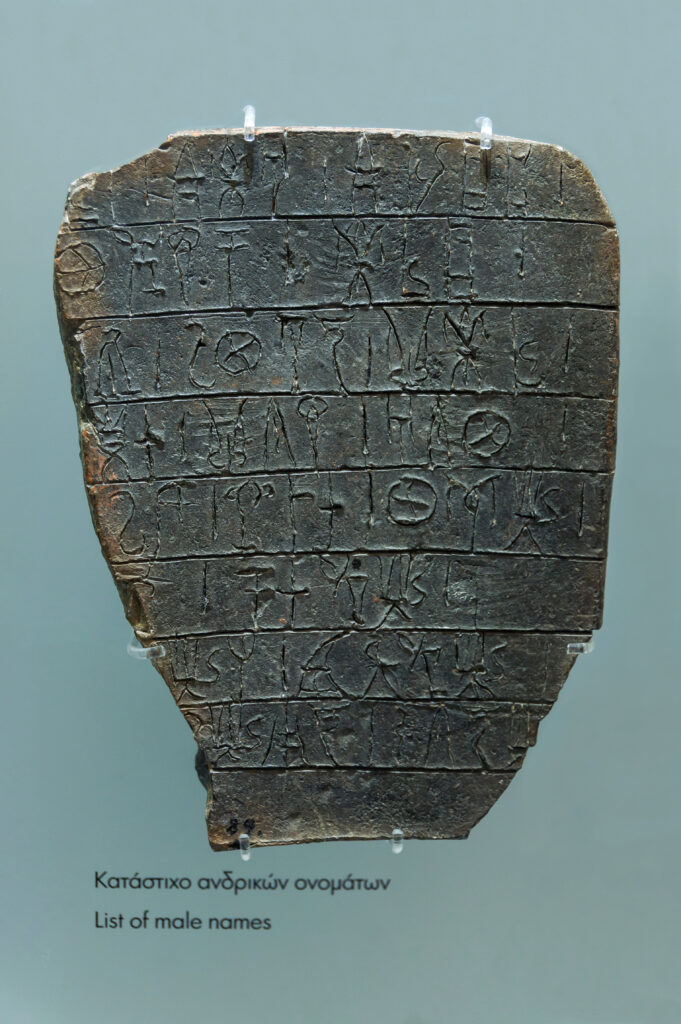
What the tablets hold is not romance. It is inventory, and that is exactly the point. The Knossos archive runs to more than four thousand tablets, and it lists wine next to grain, oil, livestock and cloth. One set of records counts out 420 vines and the wine they yielded. This is a palace economy treating a vineyard as an asset: counting the vines, storing the yield in graded jars, moving it through a bureaucracy. Wine had a symbol, a supply chain and a ledger. By the time the scribes at Knossos were tallying vines, wine on Crete already had two thousand years behind it.
One detail is worth resisting the urge to overuse. The name of the wine god, di-wo-nu-so, or Dionysus, does appear in Linear B, which is astonishing this early. But it shows up on tablets from Pylos on the mainland and from Chania in western Crete, not from Knossos. Worth a mention. Not worth misattributing.
Ancient wine sites in Crete you can visit
The history sits in a tight cluster in the Archanes and Skalani area, just south of Heraklion, and you can string it together with a winery or two into a genuine day out, as long as you plan around the access quirks.
Vathypetro is the anchor, the press described above, on the flank of Mount Juktas about four kilometres south of Epano Archanes. One warning. The opening hours are erratic. It is officially free and usually open in the mornings, Tuesday to Sunday, through the warmer months, with winter visits by appointment, but travellers regularly turn up to find the gate locked. Call ahead. A site this important being this loosely run is its own small scandal, but that is the reality on the ground.
The Archanes palace, known locally as Tourkogeitonia, was a major Minoan centre with fine ashlar masonry, frescoes and Linear A finds, excavated from the 1960s by Yannis and Efi Sakellarakis. Much of it lies under the modern village, which is part of the appeal. People still live on top of it.
Anemospilia, a small three-room Minoan sanctuary on the north slope of Juktas, comes with the area’s most notorious story. Excavators found a skeleton apparently bound on a platform beside a bronze blade, which some read as a human sacrifice interrupted by the earthquake that destroyed the building around 1700 BCE. That reading is genuinely disputed rather than settled, so treat it as a striking possibility, not a fact. The finds are in the Heraklion Archaeological Museum, and the site itself is not a developed attraction.
Fourni, on the ridge between the two Archanes villages, is one of the largest prehistoric cemeteries in the Aegean, in use for more than a thousand years and rich in gold that now sits in Heraklion.
And Knossos itself is ten minutes up the road, where the abstraction turns physical. The palace’s long storage magazines held rows of pithoi for oil, grain and wine, and its tablets are where the wine sign was counted. You can walk the same storerooms the accounts describe.
Crete’s indigenous wine grapes
This is where the story stops being about ruins and turns into something you can drink. Crete never stopped making wine, not through the Mycenaeans, the Romans, the long Venetian centuries when sweet Cretan Malvasia shipped all over Europe, the Ottoman period, or the phylloxera and war of the twentieth century. What came through all of that is a roster of native grapes grown almost nowhere else on earth.
One point deserves precision, because it gets abused in wine writing. You will read that these varieties “date back to the Minoans” or are “4,000 years old.” Treat that as heritage marketing, not settled fact. No ancient-DNA study has yet tied a modern bottle’s grape to a specific Minoan vine. What is proven is that Cretans have been making wine here for four millennia, and that these grapes are genuinely old, distinct, native Cretan varieties. The antiquity belongs to the place and the practice for certain, and to individual grapes only as long documented, not Minoan proven. With that said, the grapes are the real living thread.
- Liatiko is the island’s oldest and most widely planted red, a pale ruby that browns with age toward red fruit, herbs, leather and spice, made both dry and gloriously sweet from sun-dried grapes. The name comes from Iouliatiko, meaning “of July,” for how early it changes colour. The romantic claim that it goes back to the 3rd century BCE rests on grape remnants in an old press and is not confirmed. The firm paper trail is a 1609 Venetian notary’s contract naming a Liatiko vineyard, and four hundred years of documentation is still a long pedigree.
- Kotsifali is the benchmark Heraklion red, pale and high in alcohol, with cherry, cranberry and white pepper. It is usually blended for finesse.
- Mandilaria, sometimes written Mandilari, is its dark, tannic, deeply coloured partner. Where Kotsifali brings alcohol and perfume, Mandilaria brings structure and colour.
- Vidiano is the white everyone is excited about now, a nearly forgotten variety pulled back from the edge, full-bodied and stone-fruited, with peach, apricot and honey. Its revival by growers like Douloufakis and Diamantakis is the best news in Cretan wine in years.
- Vilana is the workhorse white of Heraklion, light and easy, with citrus and jasmine. Thrapsathiri is a drought-tough aromatic white that turns out to be a close genetic relative of both Vilana and Vidiano, a small, interbred family of island whites.
- Dafni and Plyto are two whites that were all but extinct until the Lyrarakis family replanted them in the early 1990s. Dafni carries an unmistakable bay-leaf note, and its name is in fact the Greek word for laurel. Plyto is melon and pear. Losing either would have meant losing something irreplaceable.
- Moschato Spinas is the Cretan Muscat, all orange blossom and lime. Romeiko, out west around Chania, is the base of Marouvas, a deliberately oxidised, sherry-like old-style wine.
These grow across four small protected zones clustered around the archaeology. Peza covers Vilana whites along with Kotsifali and Mandilari reds. Archanes is reds only, and it is the zone that physically surrounds Vathypetro and Knossos. Dafnes is Liatiko country, essentially all of it. Sitia sits out in the remote east. Beyond the four, the broad PGI Crete label covers everything else, and it is where most of the island’s experimental and international-variety bottlings live.
Crete wineries worth visiting
The striking thing about wine tourism on Crete is how tightly the good producers sit around the ruins. It is not a marketing coincidence. It is the same geography. The Minoans planted where the vines did best, and the vines still do best there. Crete is also just one stop on a wider Greek wine map, with the vineyards of the Peloponnese and the volcanic whites of Santorini each worth a trip of their own.
Boutari’s Scalarea Estate, at Skalani, has the strongest claim to the ancient-and-modern pairing. It sits about four kilometres from Knossos, inside the Archanes zone, with a full visitor centre, a room that walks you through Cretan history, and a range built on Vidiano, Assyrtiko and Muscat of Spina. If you want to see the storerooms at Knossos and then taste what the same soil makes now, this is the shortest drive on the island. The estate’s old name, Fantaxometocho, or “ghost estate,” came from a former owner who spread haunting rumours to keep pirates away, and that part is a true story.
Lyrarakis, at Alagni, is the conservationist of the group. This is the family that saved Dafni and Plyto from disappearing and built its whole identity around bringing Crete’s rare vines back. There is a dedicated visiting cellar with a vine museum and daily tastings in season. If the grapes are the living thread of this story, Lyrarakis is a big part of why some of them are still here to taste.
Douloufakis, in Dafnes, sits in the historic Liatiko heartland and is one of the two names most responsible for Vidiano’s comeback. Nikos Douloufakis runs an active, welcoming cellar. Domaine Paterianakis, at Melesses in the Peza zone, is the organic pioneer, farming without chemicals since 1988 and, by its own account, making Crete’s first certified organic wine in 1997. It is now on its third generation and focused on Vidiano and Kotsifali.
Stilianou, at Kounavoi, is a small certified-organic, dry-farmed estate working only native grapes, and it sits inside the old Knossos wine zone. You are tasting indigenous varieties, farmed the hard honest way, on ground the palace once drew wine from. Visits are by appointment. Diamantakis, at Kato Asites, and Idaia, at Venerato, both work the Dafnes region at the foot of Psiloritis, the island’s highest mountain and, in myth, the birthplace of Zeus. That is a heritage connection rather than an adjacent dig, but it is a real part of the sense of place. Idaia was founded by the oenologists Vassilis Laderos and Kalliopi Volitaki, and both estates make serious Vidiano, with Idaia’s sweet Liatiko a signature.
Silva Daskalaki, at Siva, farms biodynamically southwest of Heraklion. Domaine Economou, out in Sitia, is the island’s cult name. Yiannis Economou trained in Piedmont and Bordeaux, and he coaxes old-vine Liatiko off ninety-year-old plants, then releases it a decade or more after harvest. Economou is genuinely hard to visit, remote and appointment-only with no real booking system, so it is one to admire from the shelf as much as the cellar door.
Out west, Manousakis, which bottles under the Nostos label near Chania, is the outlier that shows the island’s range. A Greek-American family planted Rhône varieties, Syrah, Grenache and Mourvèdre, on Cretan ground in the 1990s, and they also bottle the local Romeiko as a pale Blanc de Noirs. It is the most cosmopolitan face of an island that has been taking in outside ideas about wine since the Bronze Age.
For the truly committed, a handful of small producers work in Archanes village itself, more or less next door to Vathypetro. Rhous, Menexes and Moinoterra are among them, each reviving native grapes within sight of the oldest press on the island. Confirm hours directly before you go, because these are small operations.
The same gesture, 3,600 years on
What stays with you, standing over the press at Vathypetro, is how little the basic act has changed. A modern Cretan winemaker running Vidiano into a stainless tank is doing, at bottom, exactly what the person who cut that spout was doing 3,600 years ago: getting the juice out of the fruit and away downhill before it spoils, then holding it in the biggest sealed vessel to hand. Everything around the act has changed. The act itself has not.
That is the real reason Crete gets to call itself a cradle of Greek wine. Not because it came first, because it did not, but because this is where the practice turned into a culture, the culture got written down, and the whole thing carried forward without ever quite stopping. You can drive from a Bronze Age press to a working cellar in twenty minutes and taste the far end of the same unbroken line. Very few places on earth can offer that. Crete can, and it barely bothers to mention it.
Frequently asked questions about Crete wine
Is Crete the birthplace of wine?
Not quite. The oldest wine yet found comes from Georgia, around 6000 BCE, and the oldest wine in Greece is from Dikili Tash in the north, around 4300 BCE. Crete’s claim is different, and arguably bigger. It is where Greek wine became an organised culture, with presses, storerooms and written records, and its winemaking is chemically confirmed from around 3200 to 2700 BCE.
How old is winemaking on Crete?
Chemistry pushes it back at least five thousand years. Gas chromatography on Early Minoan storage jars at the Aphrodite’s Kephali fort found tartaric acid, the fingerprint of grapes, dating to roughly 3200 to 2700 BCE. Cretans have been making wine more or less continuously ever since, for about four thousand years.
What is the Vathypetro wine press?
Vathypetro is a Minoan country house near Archanes with a treading press that is roughly 3,600 years old, one of the oldest and best-preserved in the Aegean. It is often called the oldest wine press in the world, which is not accurate, since Armenia’s Areni-1 press is older, but it is a remarkable survival that still sits in its original place.
What wine is Crete known for?
Crete’s signature is its native grapes, grown almost nowhere else. The whites include Vidiano, Vilana, Thrapsathiri, Dafni and Plyto, and the reds include Liatiko, Kotsifali and Mandilaria. They grow across four small appellations near Heraklion, Peza, Archanes, Dafnes and Sitia, plus the broad PGI Crete label.
Can you visit ancient wine sites and wineries in Crete?
Yes. The Vathypetro press, the Minoan site at Archanes and the palace of Knossos sit within a short drive of each other south of Heraklion, and several working wineries are right there too, including Boutari’s Scalarea estate about four kilometres from Knossos, Lyrarakis and Douloufakis.
Sources and further reading
- Heraklion Archaeological Museum, “The Wine Routes at the Archaeological Museum of Heraklion” (Minoan presses, the AB 131 wine sign, resination and the clay press models): heraklionmuseum.gr
- Wines of Crete, “History” (4,000 years of Cretan winemaking): winesofcrete.gr
- Patrick McGovern et al., “Early Neolithic wine of Georgia in the South Caucasus,” PNAS, 2017 (earliest wine yet found, around 6000 BCE): pnas.org
- Philip Betancourt and Andrew Koh, “Wine and Olive Oil from an Early Minoan I Hilltop Fort” (the Aphrodite’s Kephali residue study), Mediterranean Archaeology and Archaeometry: maajournal.com
- Soultana Maria Valamoti et al., “Grape-pressings from northern Greece: the earliest wine in the Aegean?” Antiquity (Dikili Tash, around 4300 BCE): cambridge.org
- Areni-1 cave winery, Armenia (the oldest known winemaking facility, around 4100 BCE): Areni-1 winery
- Vathypetro, the Minoan villa and wine press near Archanes: Vathypetro and minoancrete.com
- “Cretan wine” and the island’s indigenous grape varieties: Cretan wine and the variety profiles at winesofgreece.org